LGBTQ community centers serve over 3 million people annually.
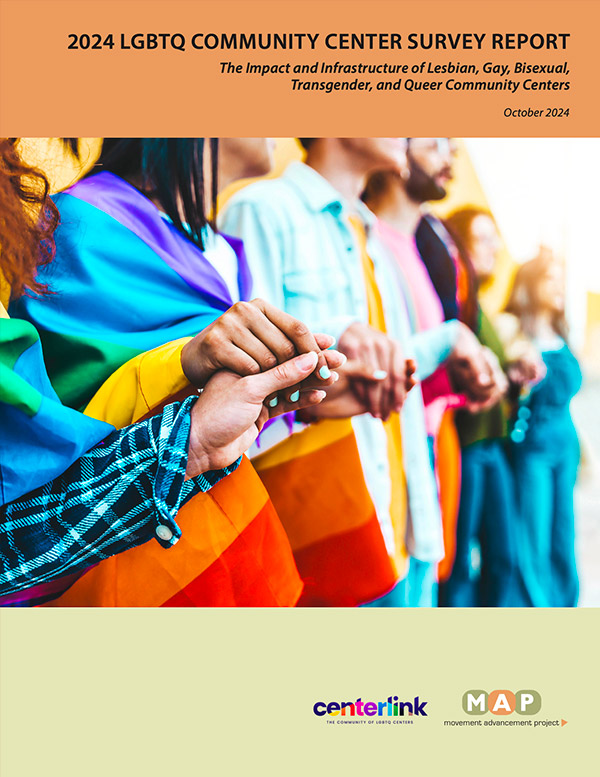
Today the Movement Advancement Project (MAP) and CenterLink released the 2024 LGBTQ Community Center Survey Report, which shows that 73% of LGBTQ centers surveyed reported they had experienced anti-LGBTQ threats or harassment over the past two years, much of which were specifically in response to anti-LGBTQ politics or rhetoric.
The 2024 LGBTQ Community Center Survey report had 199 participating LGBTQ community centers in 42 states, Washington D.C., and Puerto Rico. The biennial survey series started in 2008, highlights the crucial role these centers play in the broader LGBTQ movement, offering an invaluable link between LGBTQ people and local, state, and national efforts to advance LGBTQ equality.
“As attacks on LGBTQ people escalate year after year, we applaud these centers’ ongoing dedication to serving on the front line – meeting both the immediate and long-term needs of LGBTQ people, their families, and their communities across the country,” said Tessa Juste, LGBTQ Movement Building and Policy Researcher from the Movement Advancement Project. “This report illustrates the vital difference these centers make in people’s everyday lives, while also highlighting the urgent need for continued funding and support of these centers and the lifelines they provide.”
The report also showed that the 199 participating LGBTQ community centers collectively serve over 58,700 people each week, or over 3 million people per year, with many centers primarily serving people and communities that are historically under-resourced and under-served, including low-income, people of color, transgender people, and those under the age of 18.
“This report is a crucial guidepost for us to see the positive impact of LGBTQ centers across the U.S. as well as what areas need additional resources,” said Denise Spivak, CEO of CenterLink. “As we celebrate our 30th anniversary, this report makes clear the importance of LGBTQ centers in our communities.”
Additional Key Findings
The report breaks down program priorities, constituencies and services, infrastructure, fundraising, and staff, board, and volunteer capacity, in addition to the rising threats to safety and security experienced by centers.
Programs & Services
-
66% of LGBTQ community centers directly provide physical health, mental health, and/or anti-violence services or programs—and this number jumps to 95% of centers when including those that provide referrals to LGBTQ-friendly health providers.
-
Half of centers (50%) offer computer resources or services to the public, providing needed tools for job searching and career development, social services, schoolwork, and more.
-
Nearly all centers (92%) engage in advocacy, public policy, or civic engagement activities across a wide range of issues and areas, including over half engaging in voter registration efforts. More than one-third of centers listed anti-transgender legislation or other focus areas as their top priority, reflecting the increasingly hostile political and legislative landscape today.
Center Capacity
-
Although LGBTQ community centers reported a collective 2024 budget of over $366 million across all centers, the report shows that the financial realities of LGBTQ community centers vary greatly. Over one-third of centers have budgets of less than $250,000. In addition, over 98% of that collective budget belongs to big budget centers (budgets of $250,000 or more).
-
Funding sources also vary across the different size centers: the largest share (41%) of big budget centers reported that government grants were their top single source of revenue in 2023, while the largest share (41%) of small budget centers said individual contributions were their main source of revenue in 2023.
-
Government grants provide key resources to centers and are used to provide key services to LGBTQ and non-LGBTQ people alike in local communities across the country. Over six in ten (64%) responding LGBTQ community centers reported currently having a government grant, totaling more than $117 million in funding for needed services like health and housing.
-
While nearly half of all centers remain thinly staffed, 84% of responding centers employ paid staff, providing jobs to 3,100 people.
-
In 2023, roughly 11,600 people volunteered over 421,000 hours at responding community centers, helping centers with and without paid staff to significantly expand their reach and impact.
Methodology
The survey was conducted online in July 2024 and was distributed to LGBTQ community centers in the United States that are CenterLink members. The survey was jointly developed by MAP and CenterLink. Further details are available in the report.
###
About MAP
The Movement Advancement Project (MAP) provides rigorous research, insight, and analysis that help speed equality and opportunity for all. MAP works to ensure that LGBTQ people and their families can live their lives with dignity, safety, and respect by focusing on three key areas: policy and issue analysis, movement capacity, and effective messaging. MAP’s work also covers a broad range of social justice issues that intersect with the LGBTQ movement, including racial justice, economic justice, and healthcare access. www.mapresearch.org
About CenterLink
For 30 years, CenterLink has been at the forefront of empowering LGBTQ community centers. Our mission is clear: to strengthen, support, and connect LGBTQ community centers, enabling them to effectively serve their communities across social, cultural, health, and advocacy areas. CenterLink facilitates over $1.5 million in collaborative funding annually, ensuring our centers have the resources to continue making a meaningful impact. We provide essential resources, guidance, and a collective voice to our emerging and established centers. www.lgbtqcenters.org