You are here:

LGBTQ Community Center Survey Report

Authors

Movement Advancement Project
CenterLink

Report Resources

2024 LGBTQ Community Center Survey Report
Download
2024 LGBTQ Community Center Survey Report: CyberCenters
Download
2024 LGBTQ Community Center Survey Report: Infographics
View
2022 LGBTQ Community Center Survey Report
Download
2022 LGBTQ Community Center Survey Report: CyberCenters
Download
2022 LGBTQ Community Center Survey Report: Infographics
View
2020 LGBTQ Community Center Survey Report
Download
2020 LGBTQ Community Center Survey Report: CyberCenters
Download
2020 LGBTQ Community Center Survey Report: Infographics
View
2018 LGBT Community Center Survey Report
Download
2018 LGBT Community Center Survey Report: CyberCenters
Download
2018 LGBT Community Centers & Advocacy: Infographic
View
2016 LGBT Community Center Survey Report
Download
2016 LGBT Community Center Survey Report: CyberCenters
Download
2014 LGBT Community Center Survey Report
Download
2014 LGBT Community Center Survey Report: CyberCenters
Download
2012 LGBT Community Center Survey Report
Download
2010 LGBT Community Center Survey Report
Download
2008 LGBT Community Center Survey Report
Download

Recommended Citation

Movement Advancement Project and CenterLink. October 2024. 2024 LGBTQ Community Center Survey Report. https://mapresearch.org/report/lgbtq-community-center-survey-report/.

The Bottom Line

The 2024 biennial LGBTQ Community Center Survey Report provides a detailed picture of centers’ staff and boards, program priorities,  constituencies and services, infrastructure, fundraising, budgets, and technical assistance needs. The 2024 report finds that local community centers serving LGBTQ people  provide vital information, education, and health services to over 58,700 people each week — i.e., more than 3 million people per year.


Abstract

The 2024 LGBTQ Community Center Survey Report, prepared jointly by MAP and CenterLink and published every two years, provides an overview of local lesbian, gay, bisexual, transgender, and queer (LGBTQ) community centers, including their capacity, their programs and services, the people they serve, and their major challenges and opportunities. 
 
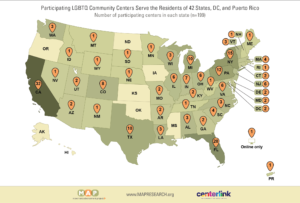
This year, the report surveyed 199 centers located in 42 states, the District of Columbia, and Puerto Rico, and provides a crucial snapshot of the centers that provide vital services, programs and advocacy for LGBTQ people. Among the report’s key findings: 
 

  • Community centers collectively serve over 58,700 people each week, with many centers primarily serving people and communities that are historically under-resourced and under-served, including low-income, people of color, transgender people, and those under the age of 18.   


  • 66% of LGBTQ community centers directly provide physical health, mental health, and/or anti-violence services or programs—and this number jumps to 95% of centers when including those that provide referrals to LGBTQ-friendly health providers.


  • Overall, 73% of LGBTQ centers reported they had experienced anti-LGBTQ threats or harassment over the past two years.


  • Nearly all centers (92%) engage in advocacy, public policy, or civic engagement activities, across a wide range of issues and areas, including over half engaging in voter registration efforts. More than one-third of centers listed anti-transgender legislation or other focus areas as their top priority, reflecting the increasingly hostile political and legislative landscape today.


  • The staff at LGBTQ centers are diverse, frequently mirroring the communities they serve. Across centers that reported this information, a majority of all center staff (63%) and of all senior staff (52%) are people of color, while 40% of executive directors are people of color. Notably, LGBTQ community centers employ many transgender people, with one in five (20%) paid staff and 24% of executive directors at responding centers identifying as transgender. 

Related resources

LGBTQ People
LGBTQ people in the United States have families, work hard to earn a living, pay taxes, and serve their communities and their country. MAP offers a collection of resources addressing the many aspects of LGBTQ people’s lives.
LGBTQ Organizations

What is the state of LGBTQ organizations’ financial health? How are statewide organizations balancing their work among various movement priorities, such as legislation, public education, coalition work and electoral campaigns? Which key LGBTQ issues are these organizations focused on right now? How have the lingering effects of the recent economic

Community Center Survey Reports
Released every two years, this report provides a detailed picture of centers’ staff and boards, program priorities, constituencies and services, infrastructure, fundraising, budgets, and technical assistance needs.
2025 National LGBTQI Movement Report
This publicly available report series offers an annual snapshot look at the national LGBTQI movement’s revenue and expenses, fundraising, and other indicators of financial health.
The Power of Affirming Community: How Local Spaces Support LGBTQ Youth Outcomes
Despite the Attacks Against Us, LGBTQ+ People Know How to Win
From defeating harmful legislation, to regional, grassroots efforts, to local community centers, there are many ways that LGBTQ people continue to win.
2024 LGBTQ Community Center Survey Report Infographics

The following infographics are drawn from the 2024 LGBTQ Community Center Survey Report: The Impact and Infrastructure of Lesbian, Gay, Bisexual, Transgender, and Queer Community Centers, authored by the Movement Advancement Project (MAP), in partnership with CenterLink.

COVID Pulse Survey Report Series: 2020–2023
Since the start of the COVID-19 pandemic, MAP published a series of reports with data from LGBTQI organizations about their operations, finances, and programs. They demonstrate the flexibility and continued resilience of LGBTQI and allied organizations.
Unrestricted and Unprecedented: The Impact of MacKenzie Scott’s Large Gifts on LGBTQ Organizations (Infographics)

The following infographics are drawn from Unrestricted and Unprecedented: The Impact of MacKenzie Scott’s Large Gifts on LGBTQ Organizations, authored by the Movement Advancement Project (MAP).

Join our community

Get research updates, stories, and ways to support.