As state legislatures across the country become more polarized, citizens are increasingly turning to direct democracy to protect fundamental rights and advance popular policies that elected officials refuse to address. But the success of recent initiatives has prompted strong backlash from some state legislatures opposed to those efforts, leading to several states passing new restrictions that make it harder for citizens to utilize this powerful tool.
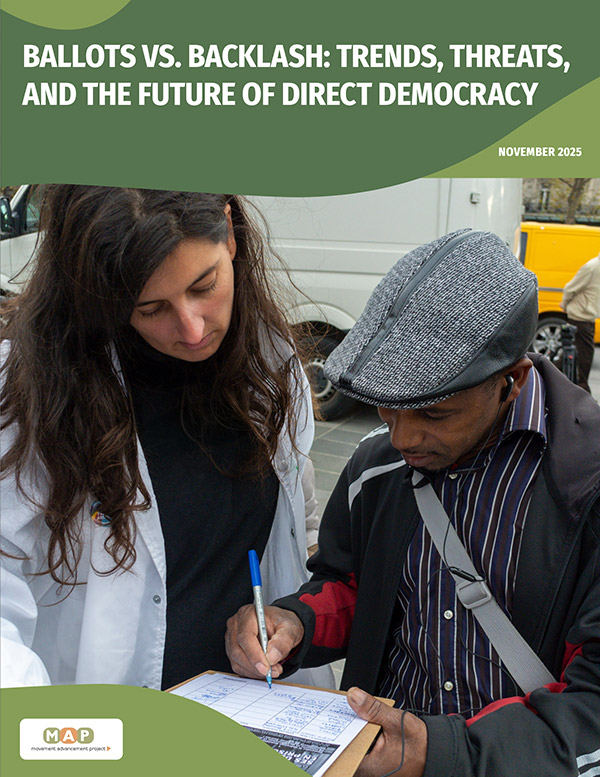
Today, the Movement Advancement Project (MAP) released a new report, Ballots vs. Backlash: Trends, Threats, and the Future of Direct Democracy. The report examines how direct democracy works across the states and the ways in which state legislatures are trying to restrict these processes. Efforts to limit access to direct democracy raise serious concerns; by making it more difficult for citizens to exercise rights guaranteed in state constitutions, public trust is undermined, and our democratic institutions are weakened.
While polling consistently shows broad public support for policies ranging from reproductive rights to fair wages, state legislatures often refuse to act. This situation is sometimes referred to as a “representation crisis” where elected officials are more responsive to partisan ideology and special interests than to the voters who put them in office.
In response, citizens have turned to direct democracy to bypass their indifferent legislatures. Direct democracy is a broad term that refers to processes outlined in state constitutions where citizens can propose and vote directly on laws and policies themselves, rather than relying on elected representatives to make those decisions for them.
“The growing disconnect between public opinion and legislative action has created increased demand for direct democracy,” said Brian Hinkle, Senior Voting Policy Researcher at MAP. “But the same forces driving this disconnect are working to restrict these tools.”
Although recent successes have demonstrated the power of this approach, these victories have triggered a severe backlash, with conservative state legislatures launching an unprecedented attack against these democratic actions. The result is a dangerous erosion of one of the fundamental principles of democracy: the right of citizens to directly participate in their own governance.
Important Note — Any discussion of the citizen initiative process and its impacts must grapple with an underlying tension: while initiatives have often served as a vehicle for the expansion of rights, they have also been used to restrict the rights of minority groups. Recent examples include bans on marriage and relationship recognition for same-sex couples, strict voter ID policies, anti-immigrant policies, and other restrictive measures.
The Current Landscape
Although the initiative process dates back to the late 1800s, recent history has seen a surge in citizen-initiated ballot measures, particularly in key issues like reproductive rights, electoral reform, economic justice, and health.
While there are three main processes by which measures can be placed on the ballot, this report focuses specifically on the direct citizen initiative, where measures proposed by citizens are put on the ballot without involvement from the state legislature if they meet certain qualifications such as signature gathering.
Currently, 19 states have a direct citizen initiative process, representing 37% of the country’s voting-eligible population. The requirements for getting an initiative on the ballot differ widely between states, but the process typically includes a common series of steps.

Increasing Extremism of State Legislatures
Over the past decade, growing ideological extremism and polarization — exacerbated by the new Administration in Washington — has played a major role in why citizens are increasingly turning to direct democracy. On multiple issues ranging from reproductive freedom to drug legalization, polling data reveals that lawmakers are frequently out of step with public opinion. Recent citizen-led victories for policies that are opposed by conservative state legislatures have resulted in backlash from those same legislatures as they seek to restrict and undermine the initiative process. Systematic efforts include:
- Expanding Signature Requirements – Since 2018, at least seven states have passed laws to increase the number of petition signatures required to get on the ballot.
- Increasing Geographic Distribution Requirements – At least five states have recently passed laws increasing the geographic distribution requirements for signature gathering.
- Costly Financial and Administrative Burdens – In recent years, a number of states have heightened financial and administrative hurdles, some imposing high filing fees to submit an initiative proposal.
- Limits and Restrictions on Petition Circulators – Some states have recently implemented numerous restrictions on petition circulators, directly impacting who can solicit signatures and how the circulation process must be conducted.
- Supermajority Thresholds for Passage – In the last five years, at least four states have attempted to raise the threshold for initiative passage and impose a supermajority requirement.
- Legislative Interference – State legislatures have also employed numerous other tactics in their attempts to restrict the initiative process, including requiring all initiatives to have the approval of a legislative committee and giving partisan state executives power over the initiative process, allowing them to alter or reject prospective measures.
Beyond restricting the ability of citizens to propose and pass initiatives, state legislatures have increasingly moved to undermine or repeal initiatives already approved by popular vote. Data shows that of all initiatives passed between 2010 and 2023, one out of five were subsequently altered by the state legislature, which directly contradicted the will of the people.
“These extreme actions — from procedural hurdles to outright legislative sabotage — threaten to erode one of the few remaining avenues for public participation in governance,” added Hinkle. “Lawmakers, advocates, and the public need to recognize the urgency of this moment and take action to safeguard direct democracy.”
About MAP
The Movement Advancement Project (MAP) provides rigorous research, insight, and analysis that help speed equality and opportunity for all. MAP works to ensure that LGBTQ people and their families can live their lives with dignity, safety, and respect by focusing on three key areas: policy and issue analysis, movement capacity, and effective messaging. MAP’s work also covers a broad range of social justice issues that intersect with the LGBTQ movement, including racial justice, economic justice, and healthcare access. www.mapresearch.org