You are here:

Where We Call Home: Transgender People in Rural America

Authors

Movement Advancement Project

Partners

Equality Federation
National Center for Lesbian Rights
National Black Justice Coalition

Report Resources

Where We Call Home: Transgender People in Rural America: Report
Download
Infographics
Download
Rural LGBT Resources
Download
Rural Community Flyer
Download
Folleto Comunitario Rural (Español)
Download

Recommended Citation

Movement Advancement Project. November 2019. Where We Call Home: Transgender People in Rural America. https://mapresearch.org/report/where-we-call-home-transgender-people-in-rural-america/.

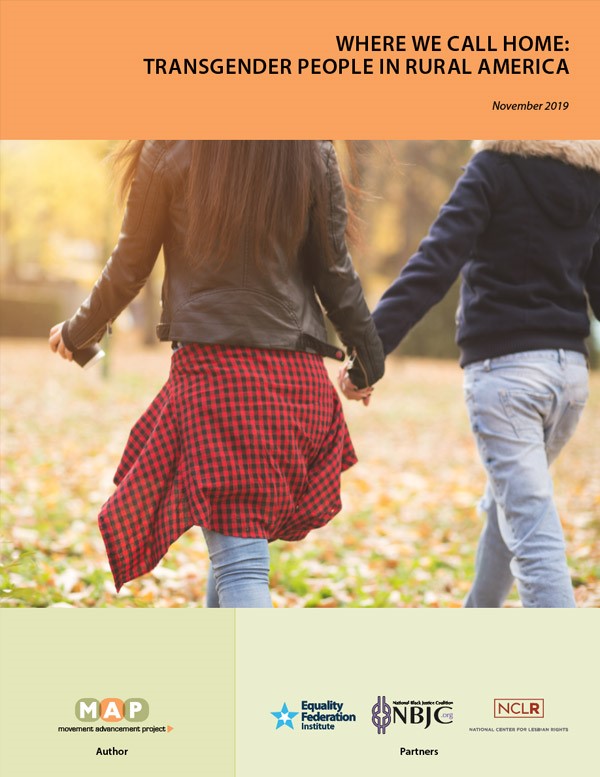
Stereotypes and pop culture portrayals often overlook the diversity of rural America, framing rural regions as made up predominantly of white, politically conservative people who are hostile to LGBT people. But millions of LGBT people, including transgender people, live in rural communities—and while some struggle, others thrive. The Movement Advancement Project (MAP) released a new report, Where We Call Home: Transgender People in Rural America,  which includes original analysis of the unique challenges and opportunities for transgender people in rural America. As the third publication in the Where We Call Home series, this report details how the structural differences of rural life amplify acceptance of or discrimination against transgender people.

This report, which includes original analysis of the 2015 U.S. Transgender Survey (USTS), offers extensive new findings on transgender people in rural communities. Although experiences of discrimination are typically as common in rural areas as in urban areas, structural challenges in rural areas, such as fewer employment or healthcare options, means the impact of discrimination on the lives of rural transgender people may be particularly profound. For example, rural transgender people are more than two times more likely—and rural transgender people of color are nearly four times more likely—as the general rural population to be unemployed and living in poverty, despite being more likely than their rural neighbors to have a college degree. 

The report concludes with recommendations for community organizations, educators, healthcare providers and policymakers to address the specific needs of transgender people in rural communities. Because transgender people in rural communities face significant obstacles to accessing and receiving care, improving access to transgender-inclusive health care that is both affordable and culturally competent is vital to adequately serving transgender patients.  Additionally, passing and enforcing transgender-inclusive nondiscrimination laws, as well as repealing discriminatory laws that disproportionately harm transgender people, will help to improve the quality of life for transgender people in rural America. 
To access all our resources and research on LGBT people in rural communities, visit our rural topic page.

Related resources

Support for Transgender People is Higher Than Headlines Suggest
This partner brief from MAP and Advocates for Trans Equality (A4TE) offers new analysis which shows that transgender people are widely accepted and supported by their families, workplaces, faith communities, and more.
Talking About ID Update Bans hero image
Talking About ID Update Bans
Identification documents are vital keys that open doors to so many parts of everyday life. Learn about conversations that can help conflicted audiences understand what’s at stake when states seek to ban transgender people from updating the gender marker on their ID.
Transgender Healthcare “Shield” Laws
Bans on Transgender People Using Public Bathrooms and Facilities According to their Gender Identity
Bans on Transgender Youth Participation in Sports
Bans on Best Practice Medical Care for Transgender Youth
Bans on best-practice medical care represent one of the most extreme and coordinated political attacks on transgender people in recent years. These bills target transgender youth by blocking their access to best-practice medical care.
Medicaid Coverage of Transgender-Related Health Care
Bans on Insurance Exclusions of Transgender-Related Care
Transgender People

An estimated 2.8 million people ages 13 and older in the U.S. identify as transgender. Transgender people live in every state, are ethnically and racially diverse, and offer a range of skills, expertise, and experiences. In recent years, the collective work of movement organizations has resulted in greater visibility and

Join our community

Get research updates, stories, and ways to support.