MEDIA CONTACT:
Rebecca Farmer, Movement Advancement Project
rebecca@mapresearch.org | 303-578-4600 ext 122
March 23, 2023
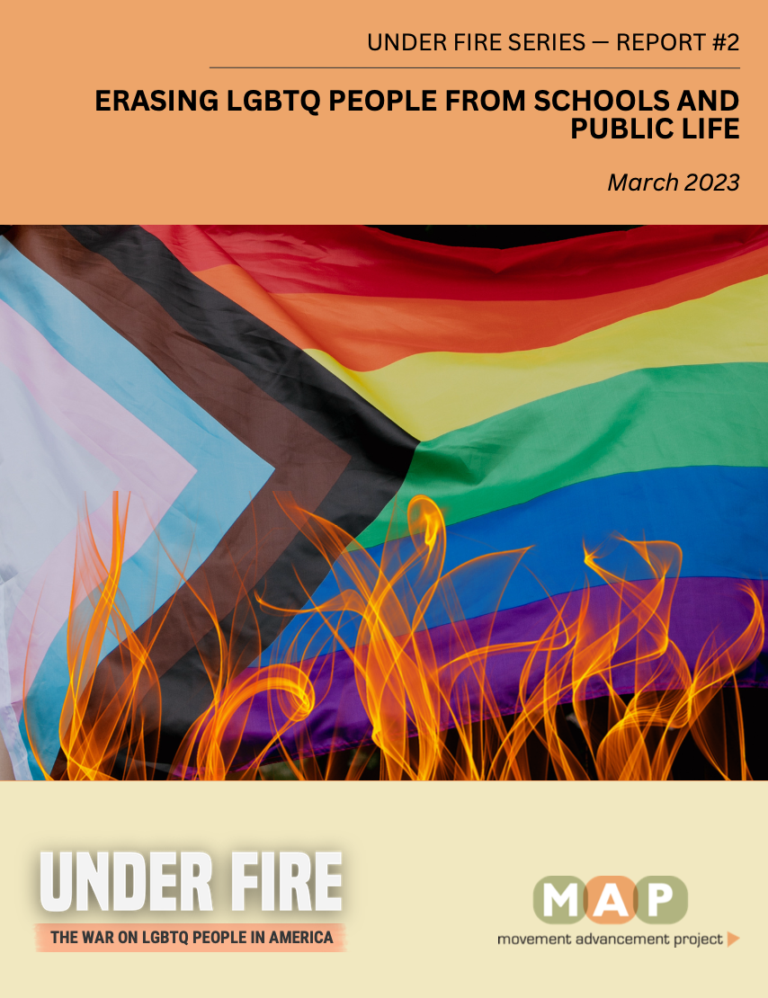
A report released today by the Movement Advancement Project (MAP) outlines how a series of coordinated political attacks is designed to erase LGBTQ people from schools and public life. The report is the second in a new MAP series, Under Fire: The War on LGBTQ People in America.
So far this year, 45 states have introduced a collective total of at least 580 anti-LGBTQ bills, surpassing the previous record. There have been more than 160 anti-LGBTQ school-specific bills introduced in the first two months of 2023.
This latest MAP report focuses specifically on ways anti-LGBTQ activists are working to completely erase LGBTQ people, and especially LGBTQ youth, from public life. In school settings their tactics include making it illegal to talk about LGBTQ people or support LGBTQ students, banning books that mention LGBTQ issues, preventing transgender youth from playing sports with their friends, and more. Efforts to limit visibility and acceptance of LGBTQ people more broadly include banning books at public libraries and bans on drag performances.
“If you look across everything they are doing, it becomes clear that their goal is to force LGBTQ people out of public life. If LGBTQ youth are unmentionable in school, if government cannot collect survey information about LGBTQ people’s lives, and if transgender youth must be called by their old names and pronouns, it will be as if LGBTQ people no longer exist,” said Naomi Goldberg, Deputy Director and LGBTQ Policy Director at MAP.
MAP identified eight specific tactics designed to erase LGBTQ people:
Tactic #1: Censoring discussions of LGBTQ people through so-called “Don’t Say Gay or Trans” curriculum bans & banning books that address LGBTQ issues.
- The first “Don’t Say Gay or Trans” laws emerged in the 1980s, but states began rescinding those laws in 2005 for a downward trend until last year. Now, more states have LGBTQ school censorship laws on the books than have since the early 1990s, erasing progress. To date, every single state legislature has considered legislation to censor what schools can say about LGBTQ people and issues.
- The number of curriculum censorship and hostile school climate bills more than quadrupled from 2020 to 2022.
Tactic #2: Enacting school policies that prevent transgender youth from being themselves and deny them access to school spaces & activities.
- In four states, transgender students are not allowed to use bathrooms that match their gender identity. Several additional states are considering these types of bills.
- In 2019 there were no state laws banning transgender youth from participating in school sports, but now these bans exist in 19 states. At least 67 bills of this kind have been introduced this year across 27 states.
- A bill moving through Congress would ban funding for schools and universities that permit transgender girls and women to play on sports teams that match their gender identity.
Tactic #3: Removing anti-bullying and harassment protections for LGBTQ students.
- Some states are attempting to rollback or repeal protections for LGBTQ youth within their state nondiscrimination or anti-bullying policies.
- Florida’s Education Commissioner sent a letter to all schools in the state encouraging them to ignore federal nondiscrimination protections for LGBTQ students.
- Politicians in Iowa introduced a bill to remove gender identity protections from the state’s otherwise strong nondiscrimination law.
Tactic #4: Outlawing and criminalizing supportive school environments, including firing or suing teachers.
- States such as Missouri are attempting to create harsh penalties for teachers who violate censorship laws, including revoking teaching licenses and allowing them to be sued.
- Bills in several states would require schools to notify a parent if their child uses a different name or pronoun, or if the student changes their gender expression—without consideration for student safety. The states considering this type of bill include Iowa, Kentucky, and Missouri. One state, Alabama, has already passed such a law.
Tactic #5: Rewarding & protecting anti-LGBTQ teachers.
- States are increasingly considering bills that would create explicit protections for teachers who refuse to treat transgender students with respect, such as refusing to use a student’s preferred name and pronouns.
- Last year, a public university in Ohio settled a lawsuit with a professor for $400,000 after he refused to use a transgender student’s correct pronouns. In Kansas a middle school math teacher received $95,000 after she was suspended for refusing to follow the district’s policy to respect student pronouns.
- Some state bills would require teachers to use incorrect pronouns for transgender students—even when the teacher wants to respect the student’s wishes.
Tactic #6: Pulling out of longstanding school survey efforts.
- States like Florida are refusing to participate in data collection about LGBTQ young people such as the Youth Risk Behavior System survey, which tracks important information about the well-being of young people and have been instrumental in highlighting the experiences of LGBTQ youth, specifically.
Tactic #7: Purging public libraries.
- According to the American Library Association, the number of documented attempts to ban books from libraries in 2022 exceeded the record set the previous year.
- Half of the top 10 most challenged books in 2021 were targeted because of LGBTQ content.
Tactic #8: Regulating drag shows.
- Many of the bills that restrict drag performances would effectively prohibit transgender and non-binary people in public places, and sometimes include criminal penalties.
- At least 47 bills introduced in 17 states target drag performances.
“An overwhelming majority of Americans consistently support LGBTQ equality but aren’t yet aware of the scope and scale of how that equality is being swiftly eroded. There is a war against LGBTQ people in America—and the ability of LGBTQ people to openly exist is under serious fire,” said Ineke Mushovic, Executive Director of MAP.
A new series of reports from MAP connects the dots on the varied ways that LGBTQ people are under siege from a targeted and coordinated campaign to undermine equality and ultimately erase LGBTQ people from public life. The series makes clear that, despite significant policy advances for LGBTQ equality over the last decade, LGBTQ people are facing an unprecedented firestorm of attacks on all fronts.
While public attention often lands on a particular type of anti-LGBTQ legislation or handful of hostile states, the series outlines the ways that opponents of LGBTQ equality are working systematically across the country—in legislatures, schools, and in the media— to erase LGBTQ people from society.
Last year saw a record number of anti-LGBTQ bills (315 bills) introduced in state legislatures, and 2023 has already far exceeded that number. According to MAP’s internal tracking, the number of anti-LGBTQ bills introduced in the first months of 2023 is more than the anti-LGBTQ bills introduced in all of 2012, 2013, 2014, and 2015 combined.
MAP’s mission is to provide independent and rigorous research, insight and communications that help speed equality and opportunity for all. MAP works to ensure that all people have a fair chance to pursue health and happiness, earn a living, take care of the ones they love, be safe in their communities, and participate in civic life.