MEDIA CONTACT:
Rebecca Farmer, Movement Advancement Project
rebecca@lgbtmap.org | 303-578-4600 ext 122
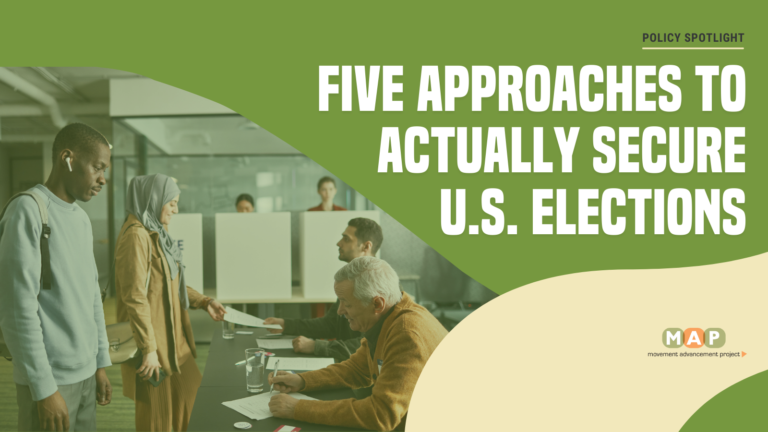
September 21, 2022 — With just six weeks until the 2022 midterm general election, the Movement Advancement Project (MAP) released a new report, Policy Spotlight: Five Approaches to Actually Secure U.S. Elections.
“The fake cries of election fraud are actively harming our election system and, as a result, jeopardizing our very democracy. Rather than focusing on things that actually secure elections, some politicians have distracted Americans with lies and seek to restrict the ability of eligible voters to cast a ballot,” said Ineke Mushovic, Executive Director at MAP.
“What’s worse is that the bold-face lies are both a distraction and an attack on truly ensuring that American elections are free, fair, and secure. The reality is that false narratives and big lies leave our elections vulnerable to serious threats – both from other countries and from within our borders,” said Mushovic.
The report details five policy approaches that states should adopt to truly secure elections, while also ensuring that every eligible voter is able to easily cast their vote.
Protecting Election Officials from Threats and Harassment
Preventing Insider Threats
Modernizing Voter Registration
Secure Technology for In-Person Voting and Voting by Mail
Appropriate Use of Post-Election Audits
Election Security Approach 1: Protecting election officials from threats and harassment
Threats to election officials have risen to unprecedented levels following the 2020 election. A recent survey from the Brennan Center found that 1 in 3 election officials reported feeling unsafe because of their jobs and that 1 in 5 were concerned about threats to their lives.
The MAP report outlines the ways that horrific threats to election officials and their families – including death threats – have resulted in a mass exodus of qualified, experienced officials. The U.S. Department of Justice recently established an Election Threats Task Force, in part to address these threats. MAP’s Democracy Maps show that only three states (Colorado, Oregon, and Maine) have enacted laws that provide additional protections to election officials.
Election Security Approach 2: Preventing Insider Threats
The security and integrity of our elections have been threatened by bad faith actors working on the inside to sabotage election equipment and potentially impact election results. For example, election officials have granted unauthorized access to voter information and election results to political operatives. Resulting breaches have occurred in at least five states, including Colorado, Georgia, Michigan, Ohio, and Pennsylvania.
States could enact laws – like Colorado did this year to increase election security by increasing penalties for facilitating authorized access to voting equipment and ensuring proper monitoring of voting equipment and systems. The federal Cybersecurity and Infrastructure Security Agency has also advised all states to adopt policies similar to those in Colorado.
Election Security Approach 3: Modernizing Voter Registration
Three key policies can modernize voter registration while improving election security, increasing access, and lowering barriers to voting: automatic voter registration, ensuring accuracy of voter rolls, and online voter registration.
With automatic voter registration (AVR), eligible voters are automatically registered through their interactions with various state agencies, such as a DMV. As shown on MAP’s Democracy Maps, 22 states have some form of automatic voter registration; 16 of those states implemented front-end AVR and six of those states implemented back-end AVR. However, more than half of eligible voters live in states that have not adopted automatic voter registration. (See MAP’s report on automatic voter registration for more information.)
Currently 42 states allow online voter registration – which represents roughly 90% of eligible voters nationwide.
A vital step in administering a secure election is having accurate and updated voter rolls. The Electronic Registration Information Center (ERIC) assists states in improving the accuracy of the voter rolls, which increases both efficiency and security. As tracked in our Democracy Maps, 32 states are currently members of ERIC.
Election Security Approach 4: Secure Technology for In-Person Voting and Voting by Mail
For in-person voting, the use of voter-verified paper ballots is a core way to ensure the security of voting machines and guard against interference. In 37 states, the majority of voters can use secure voting machines with a verifiable paper trail, as tracked on our Democracy Maps.
Mail voting has been used since the Civil War; the first absentee voters were soldiers casting their ballots from the battlefield. Voting by mail is still a proven secure way for many service members to vote, in addition to civilians. Online ballot tracking is an important way that states can further improve security of mail voting.
Voters can ensure that their ballot is received and counted, and election offices are better able to track ballots. Nearly every state allows voters to track the status of their vote by mail ballot. Only five states – Illinois, Mississippi, Missouri, Texas, and Wyoming – don’t allow all voters to track the status of their mail ballot.
Election Security Approach 5: Appropriate Use of Post-Election Audits
Truly independent and nonpartisan audits following an election are a best practice in election administration – assuming that those audits are legitimate and truly nonpartisan. Already 39 states require routine post-election audits that are nonpartisan.
An additional method to ensure the security and integrity of elections is through risk-limiting audits, which use statistical methods to analyze samples of ballots to ensure the accuracy of election results. Currently only 12 states conduct best-practice risk-limiting audits.
More about MAP’s Democracy Maps Project
The Democracy Maps project tracks more than 40 state election laws and policies and seeks to improve understanding about the health of democracy in the states. We produce policy briefs and analyses, track policies in real-time, and offer expert commentary about democracy and elections in the United States.