MEDIA CONTACT:
Rebecca Farmer, Movement Advancement Project
rebecca@mapresearch.org | 303-578-4600 ext 122
May 16, 2023
A new report from MAP, How Election Denialism Threatens Our Democracy and the Safeguards We Need to Defend It, measures the level of risk to each state posed by election denialism, the resulting threats when the proper safeguards are not in place. The report also offers more than 10 recommendations for ways in which states can protect their elections from election deniers.
“All but one battleground state from the 2020 election are at a risk of election denialism. Without action now by state legislatures, we’re likely to see the same chaos around the results of the 2024 general election. The time is now for states to enact policies to strengthen election laws to prevent election deniers from pushing our democracy to the brink,” said Ineke Mushovic, Executive Director of MAP.
The National Election Denial Risk Index is a tool for lawmakers, journalists, and the public that can be used to examine the range of ways that election denialism poses a threat to each state and which policies can strengthen a state’s ability to combat these threats. The Index is a composite of several voting and election policies tracked by the Democracy Maps as well as seven additional policies.
Takeaways from analysis based on the National Election Denial Risk Index include:
- Only one battleground state from the 2020 election (Michigan) is at lower risk of threats from election denialism, in part due to strong policies like best practice post-election audits and protections against partisan interference in the election certification process.
- Seven battleground states fall in the moderate risk category (Arizona, Florida, Georgia, Nevada, North Carolina, Pennsylvania, and Wisconsin). Battleground states in the last presidential election had slim margins of victory, making policies to defend against election denialism all the more important to ensure our elections are free from interference.
- Only two states fall in the lowest risk category: Colorado and Oregon.
- Virginia has the third lowest risk of election denialism, faring better than California, New York, and Washington.
- Six states fall into the highest risk category for threats posed by election denialism: Alabama, Louisiana, Mississippi, South Dakota, Texas. An estimated 29 million eligible voters live in these states.
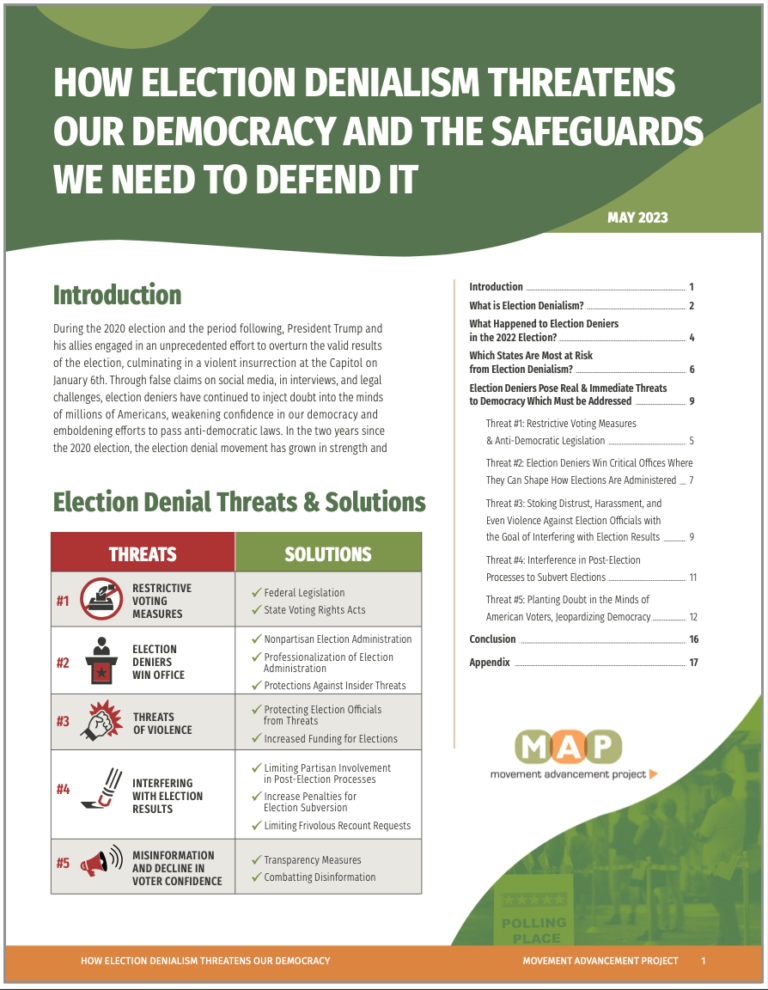
The report also outlines five key threats to our democracy that result from election denialism and offers solutions:
- Threat #1: Enacting restrictive voting measures and anti-democratic legislation.
Solutions include passing federal voting rights legislation and state voting rights acts.
- Threat #2: Election deniers winning critical offices where they can shape how elections are administered.
Solutions include nonpartisan and professional election administration, as well as protection from insider threats.
- Threat #3: Stoking doubt, harassment, and even violence against election officials with the goal of interfering with election results.
Solutions include legislation to specifically protect election officials from threats and increasing funding for elections to ensure security measures and other proper infrastructure.
- Threat #4: Interfering in post-election processes to subvert election results.
Solutions include limiting partisan involvement in post-election processes, increasing penalties for election subversion, and limiting frivolous recount requests.
- Threat #5: Planting doubt in the minds of American voters which jeopardizes democracy.
Solutions include transparency measures to restore voter confidence and combatting election disinformation.
The report makes clear that action must be taken now at the state and national level. By enacting legislation to protect voting rights, insulating election administration systems from partisan actors, protecting election officials who are acting in good faith from threats, and taking measures to increase voter confidence, our democracy can be protected, preserved, and even further strengthened.
“While the claims of election deniers didn’t ultimately upend our elections in 2022, election deniers still post serious threats to our democracy which need to be addressed. States still have time before the 2024 elections to fill the gaps in policies that put their state at risk of election denialism,” said Brian Hinkle, Voting Policy Researcher at MAP.
MAP’s mission is to provide independent and rigorous research, insight and communications that help speed equality and opportunity for all. MAP works to ensure that all people have a fair chance to pursue health and happiness, earn a living, take care of the ones they love, be safe in their communities, and participate in civic life.