You are here:

Talking About Religious Exemptions (Archived Guide)

Authors

Movement Advancement Project

The Bottom Line

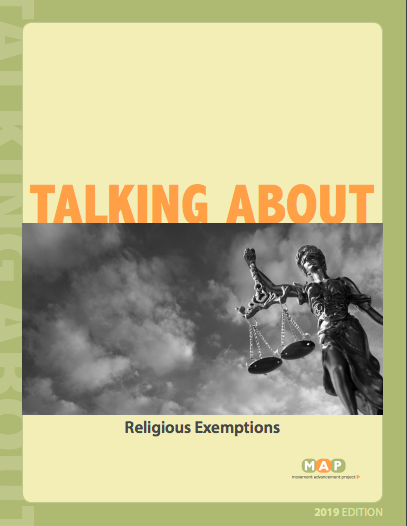
Newly Updated for 2019. Talking About Religious Exemptions is a guide to building effective conversations about the ways in which harmful religious exemptions threaten public safety, access to health care (including women’s reproductive health), the best interests of children in state care, laws protecting Americans from discrimination, and more.

The guide offers approaches for talking about both broad religious exemptions laws (like proposed state RFRAs) as well as religious exemptions intended to encourage adoption and foster care discrimination and service discrimination—elevating effective discussions about the ways these harmful exemptions can be used to deny children loving forever homes; encourage discrimination against LGBT people, religious minorities, people of color, women and others; threaten health care and women’s reproductive health; and put the rule of law itself at risk.

Talking about Religious Exemptions

Download

Recommended citation:

Movement Advancement Project. January 2019. “Talking About Religious Exemptions (Archived Guide)“. MAP’s Talking About LGBTQ Issues Series. https://mapresearch.org/messaging-guide/talking-about-religious-exemptions/.

Related resources

History of MAP: Building Common Ground Through Messaging
This blog highlights the legacy and ongoing impact of MAP’s messaging work. Alongside this history, we include several perspectives from MAP’s strongest supporters.
In This Moment, It’s Crucial That States Protect LGBTQ+ Data
As federal data collection on LGBTQ+ people is scaled back, states and localities are increasingly being called on to fill widening gaps in research and data on LGBTQ+ communities.
The Supreme Court Just Upheld State Mail Ballot Receipt Deadlines
In June 2026, SCOTUS ruled that federal Election Day statutes do not prevent states from counting mail ballots that are postmarked by Election Day but arrive afterward. This blog summarizes the decision, which preserves mail ballot grace periods in 14 states and D.C. ahead of the 2026 midterms.
History of MAP: Leading Through Collaboration
This third installment of our spotlight anniversary series identifies important examples of collaboration and partnership across MAP’s history.
State-Level Sexual Orientation and Gender Identity Data Practices: Inclusive Data, Responsible Governance
This report maps the landscape of state-level SOGI data collection, assesses emerging risks of data misuse, and identifies policies and practices for leaders committed to ethical, responsible data governance.
Advancing Responsible State-Level SOGI Data Practices

Collection of data on sexual orientation and gender identity (SOGI) by government entities can be a powerful tool to understand the experiences, needs, and disparities affecting LGBTQ+ populations, informing evidence-based policymaking, strengthening program accountability, and supporting civil rights enforcement. As federal efforts to collect LGBTQ-inclusive data are scaled back, state

History of MAP: Tracking Equality and Democracy Through State Policy
In this second installment of our “History of MAP” series, we highlight MAP’s extensive collection of policy research — from its origins in the early 2000s to its most recent expansion through the Democracy Program.
Support for Transgender People is Higher Than Headlines Suggest
This partner brief from MAP and Advocates for Trans Equality (A4TE) offers new analysis which shows that transgender people are widely accepted and supported by their families, workplaces, faith communities, and more.
Democracy Maps Updates: June 2026

Join our community

Get research updates, stories, and ways to support.