You are here:

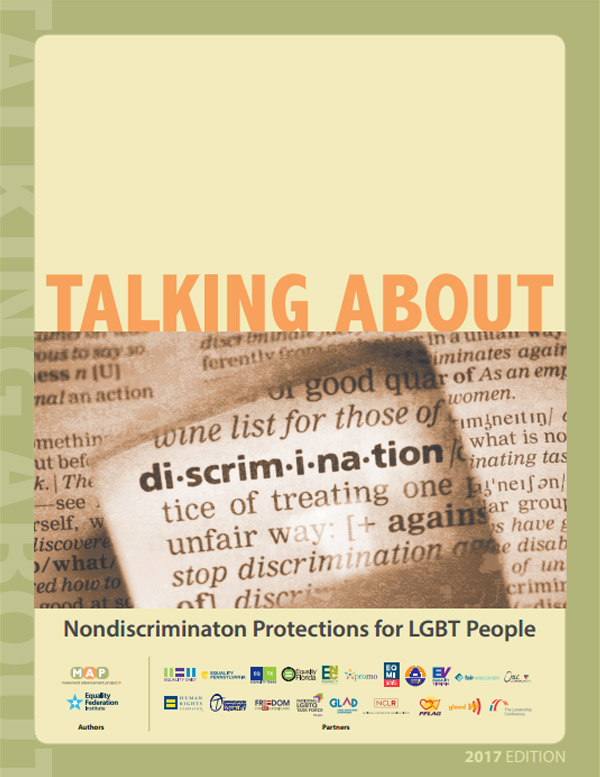
Talking About Nondiscrimination Protections for LGBT People (Archived Guide)

Authors

Movement Advancement Project
Equality Federation Institute

Partners

Equality Ohio
Equality Pennsylvania
Equality Texas
Equality Florida
Equality North Carolina
PROMO
Equality Michigan
Georgia Equality
Equality Virginia
Fair Wisconsin
ONE Community
Human Rights Campaign
National Center for Transgender Equality
Freedom for All Americans
National LGBTQ Task Force
GLAD
National Center for Lesbian Rights
PFLAG
GLAAD
The Leadership Conference on Civil and Human Rights

The Bottom Line

Solid majorities of Americans support protecting lesbian, gay, bisexual and transgender (LGBT) people from discrimination in employment, housing and public accommodations. However, that support cannot be taken for granted, as many Americans mistakenly believe that LGBT people are already protected from discrimination. And when opponents of equality introduce false, fear-based attacks on nondiscrimination protections, people can often lose sight of their core values.

Talking About Nondiscrimination Protections for LGBT People provides conversation approaches to help build and sustain solid, lasting support for nondiscrimination laws, and also factually and effectively address concerns that might be raised when discussing the need for such laws. Among them: emphasize the values that are at the heart of people’s existing support for nondiscrimination; explain why nondiscrimination protections are important and needed; share stories and model people’s journey toward solid support; and help conflicted audiences think through and calm their own anxieties—all while avoiding missteps that can inadvertently intensify those concerns.
Talking About Nondiscrimination Protections for LGBT People

Download

Recommended citation:

Movement Advancement Project and Equality Federation Institute. January 2017. “Talking About Nondiscrimination Protections for LGBT People.” 2017 Edition. MAP’s Talking About LGBTQ Issues Series. https://mapresearch.org/messaging-guide/talking-about-nondiscrimination-protections-for-lgbt-people/ June 12, 2026.

Related resources

History of MAP: Tracking Equality and Democracy Through State Policy
In this second installment of our “History of MAP” series, we highlight MAP’s extensive collection of policy research — from its origins in the early 2000s to its most recent expansion through the Democracy Program.
Support for Transgender People is Higher Than Headlines Suggest
This partner brief from MAP and Advocates for Trans Equality (A4TE) offers new analysis which shows that transgender people are widely accepted and supported by their families, workplaces, faith communities, and more.
Democracy Maps Updates: June 2026
History of MAP: Analyzing the Movement’s Capacity
Equality Maps Updates hero
LGBTQ Equality Maps Updates: May 2026
In this rapidly changing landscape, MAP’s LGBTQ Equality Maps provide a detailed snapshot of the current state of LGBTQ laws and policies in the United States. See below for a listing of state level policy changes and MAP’s bill tracking updates as of May 26, 2026.
Mapping Democracy
This collection of voting and election-related resources includes periodic updates of state level policy changes, comprehensive retrospectives, legislative wrap-ups and forecasts.
Mapping Equality
This collection of LGBTQ-related resources includes periodic updates of state level policy changes and bill tracking, comprehensive retrospectives, legislative wrap-ups and forecasts.
The Supreme Court’s Decision to Gut the VRA Means State-Level Protections are More Important Than Ever
This analysis details the impact of the Callais decision and how states have responded to SCOTUS weakening the federal Voting Rights Act.
Talking About ID Update Bans hero image
Talking About ID Update Bans
Identification documents are vital keys that open doors to so many parts of everyday life. Learn about conversations that can help conflicted audiences understand what’s at stake when states seek to ban transgender people from updating the gender marker on their ID.

Join our community

Get research updates, stories, and ways to support.