
You are here:

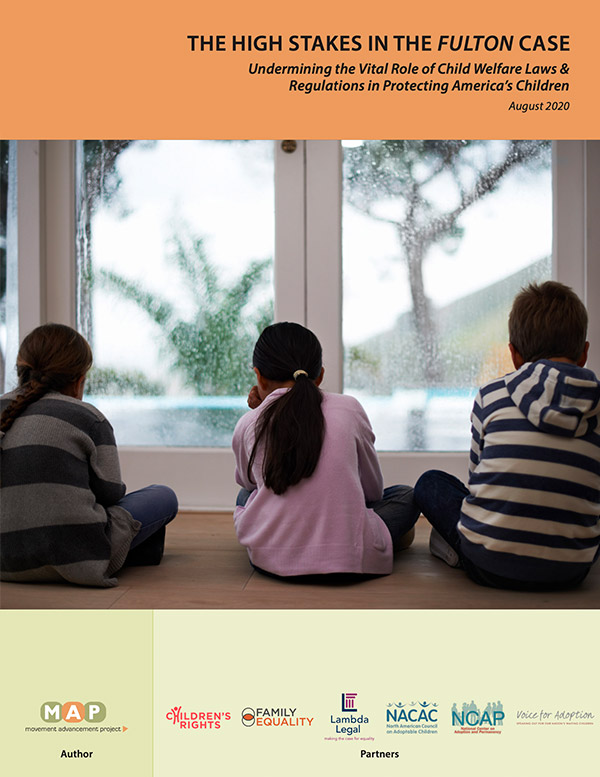
The High Stakes in the Fulton Case: Undermining the Vital Role of Child Welfare Laws & Regulations in Protecting America’s Children

Authors

Movement Advancement Project

Partners

Children's Rights
Family Equality
Lambda Legal
National Center on Adoption and Permanency
North American Council on Adoptable Children
Voice for Adoption

Report Resources

The High Stakes in the Fulton Case: Undermining the Vital Role of Child Welfare Laws & Regulations in Protecting America’s Children (PDF)
Download
Infographics
Download
Press Release: Religious Exemptions in Child Welfare System Would Harm Millions of Children
Visit
Issue Briefs: What's at Stake in the Fulton Case
Visit

Recommended Citation

Movement Advancement Project. August 2020. The High Stakes in the Fulton Case: Undermining the Vital Role of Child Welfare Laws & Regulations in Protecting America’s Children. https://mapresearch.org/report/the-high-stakes-in-the-fulton-case-undermining-the-vital-role-of-child-welfare-laws-regulations-in-protecting-americas-children/.

This fall, the U.S. Supreme Court will hear oral arguments in Fulton v. City of Philadelphia, a case related to taxpayer-funded child welfare agencies. If the Court rules that Catholic Social Services (CSS) can refuse to comply with the City of Philadelphia’s nondiscrimination requirement and reject qualified parents simply because of who they are or what religion they are, it is children who will ultimately pay the price.

This report highlights what is at stake in Fulton v. City of Philadelphia, a case that could harm children and families in the child welfare system and jeopardize the ability of governments to enforce nondiscrimination protections more broadly.

The report examines the potential outcomes of the Fulton v. City of Philadelphia case and shows how a broad ruling from the Court in support of CSS could result in:

  • Religious child welfare agencies could be given a right to demand taxpayer funding while rejecting qualified and loving parents simply because they are Jewish, Catholic, LGBTQ, or single parents.
  • Nearly every religiously affiliated social service agency that receives government funding—such as job training programs, emergency shelters, and more—might claim a right to discriminate.
  • If the government is unable to set and enforce the terms of its contracts, even when paying agencies with taxpayer money, it would make it nearly impossible for state and local governments to set standards for the provision of public services.
  • Religious agencies might be able to claim a religious exemption to a wide array of regulations and laws, including those that protect public health and safety—like building codes, sanitation requirements, and food safety regulations.

A broad ruling in favor of CSS could leave millions of people without access to needed publicly funded services—and discrimination against LGBTQ people and same-sex couples, women, people of faith, unmarried couples, and more would become a regular occurrence when seeking needed social services or assistance.

Related resources

Talking About Transgender Youth Health Care
Parents of transgender children, like most parents, want to do what is best for their child—and that includes ensuring that their child is able to receive the prescribed medical care they need. Read more about why this care is so important for transgender youth, and why bans are so harmful.
The Delta Variant & the Disproportionate Impacts of COVID-19 on LGBTQ Households in the U.S.

In December 2020, MAP released an analysis of a nationally representative survey conducted by NPR, The Robert Wood Johnson Foundation, and the Harvard T.H. Chan School of Public Health (NPR/RWJF/ Harvard) showing how LGBTQ people, particularly LGBTQ people of color and those raising children, experienced higher rates of economic insecurity,

Ballot Initiatives
Often referred to generally as “ballot measures,” the initiative process is a tool through which citizens can propose statutes or constitutional amendments to be put on the ballot in their state.

Join our community

Get research updates, stories, and ways to support.