You are here:

Separation and Stigma: Transgender Youth & School Facilities

Authors

Movement Advancement Project
GLSEN

Partners

National Center for Transgender Equality
National Education Association

Report Resources

Separation and Stigma: Transgender Youth & School Facilities
Download

Recommended Citation

Movement Advancement Project and GLSEN. April 2017. Separation and Stigma: Transgender Youth & School Facilities. https://mapresearch.org/report/separation-and-stigma-transgender-youth-school-facilities/.

The Bottom Line

There are an estimated 150,000 transgender youth between the ages of 13 and 17 in America. GLSEN’s 2015 National School Climate Survey found that 75% of transgender students felt unsafe at school because of their gender expression, 50% report being unable to use the name or pronoun that matches their identity and 70% report avoiding bathrooms. Excluding transgender students from school facilities that match their gender is humiliating, discriminatory, and adds to the bullying and mistreatment that far too many transgender students already face. As this report details, this issue is not just about bathrooms, but about whether or not transgender students will be included in our public education system. If transgender students cannot safely access a bathroom, they cannot safely attend school.

Local school districts across the country, as well as 13 states and the District of Columbia, have proven they can successfully implement laws and policies protecting transgender students from discrimination while still meeting the needs of all students. Having inclusive school policies does nothing to diminish schools’ legal obligation to ensure safe school education facilities and to act if a student behaves inappropriately or tries to invade someone’s privacy.

Despite the success of inclusive policies, the federal government has signaled that transgender students cannot count on their support or protection. In 2014, the Obama administration issued official guidance clarifying that transgender students are protected from discrimination based on Title IX’s prohibition on sex discrimination. The current administration recently rescinded that guidance, leaving transgender students at higher risk for harassment and violence. As a result, the U.S. Supreme Court withdrew its decision to hear arguments in the case of Gavin Grimm, in which the Court would have considered whether Title IX’s prohibition on sex discrimination protects transgender students. Without clear federal guidance, seventeen states have introduced legislation designed to ensure transgender students are relegated to facilities that align with the sex on their birth certificate, rather than their gender identity.

Click here to read an open letter from MAP, GLSEN, NCTE and the NEA to U.S. Secretary of Education Betsy DeVos urging her to consider the findings in our report.
Related resources

Support for Transgender People is Higher Than Headlines Suggest
This partner brief from MAP and Advocates for Trans Equality (A4TE) offers new analysis which shows that transgender people are widely accepted and supported by their families, workplaces, faith communities, and more.
Talking About ID Update Bans hero image
Talking About ID Update Bans
Identification documents are vital keys that open doors to so many parts of everyday life. Learn about conversations that can help conflicted audiences understand what’s at stake when states seek to ban transgender people from updating the gender marker on their ID.
Safe School Laws
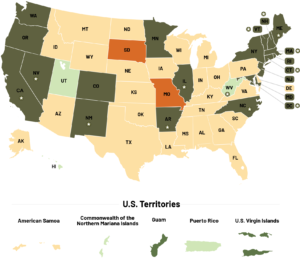
This map shows state school nondiscrimination laws that explicitly enumerate sexual orientation and/or gender identity as protected characteristics, as well as states that explicitly interpret existing prohibitions against sex discrimination to include discrimination based on sexual orientation or gender identity.
Anti-bullying
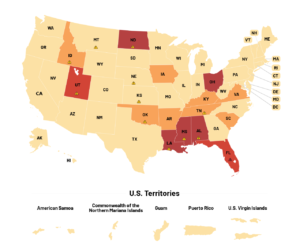
This map shows state anti-bullying laws that explicitly enumerate sexual orientation and/or gender identity as protected characteristics, as well as states that explicitly interpret existing prohibitions against sex discrimination to include discrimination based on sexual orientation or gender identity.
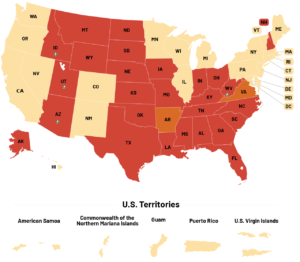
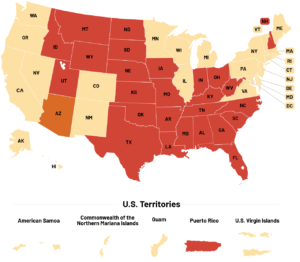
Bans on Transgender People Using Public Bathrooms and Facilities According to their Gender Identity
Bans on Transgender Youth Participation in Sports
LGBTQ Curricular Laws
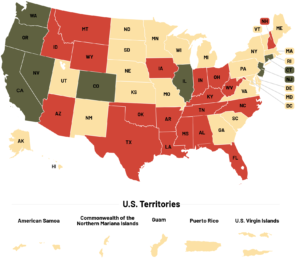
This map summarizes whether states have an LGBTQ-inclusive curricular standards law or any of the following LGBTQ-specific school censorship laws: “Don’t Say LGBTQ” laws, older laws censoring discussions of homosexuality, and parental opt-out/opt-in laws.
Bans on Best Practice Medical Care for Transgender Youth
Bans on best-practice medical care represent one of the most extreme and coordinated political attacks on transgender people in recent years. These bills target transgender youth by blocking their access to best-practice medical care.
LGBTQ-Inclusive Curricular Standards

Join our community

Get research updates, stories, and ways to support.