MAP’s newest policy spotlight, Automatic Voter Registration Best Practices in the States, details state approaches to automatic voter registration (AVR) and examines how differences in implementation of AVR can significantly impact election security and voter turnout. The report is part of MAP’s Democracy Maps project, which tracks more than 40 laws and policies related to voting and elections.
How States Implement Automatic Voter Registration Matters When It Comes to Registration and Turnout Rates
While any form of AVR results in higher voter registration rates, there are different approaches to implementing the policy which make a significant difference: “front-end” vs. “back-end” In front-end systems, the voter is given an opportunity at the time of the relevant agency transaction to decide whether to opt-out of being registered. In back-end systems, agencies such as state DMVs send information from relevant transactions to state election authorities. The voter is then automatically registered (or registered in pending status) before being given an opportunity to opt out at a later time.
While any form of AVR results in higher voter registration rates, there are different approaches to implementing the policy which make a significant difference: “front-end” vs. “back-end” In front-end systems, the voter is given an opportunity at the time of the relevant agency transaction to decide whether to opt-out of being registered. In back-end systems, agencies such as state DMVs send information from relevant transactions to state election authorities. The voter is then automatically registered (or registered in pending status) before being given an opportunity to opt out at a later time.
Whether states utilize “front-end” or “back-end” AVR matters. Recent studies show that implementing back-end AVR results in an 8.1% increase in registration, compared to 2.9% for front-end AVR. Back-end AVR also increases turnout among eligible voters (by 3.3%, compared to 1.1% for front-end AVR).
Automatic Voter Registration Landscape in the States
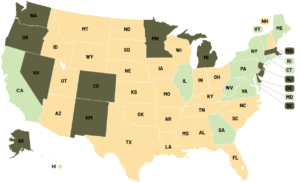
MAP’s Democracy Maps project tracks more than 40 laws and policies related to voting and elections, including a detailed map about Automatic Voter Registration policies in the states. Of the 22 states and the District of Columbia that have adopted or are currently implementing automatic voter registration, six states have chosen a back-end system while the other 16 and D.C. use some form of a front-end system.
MAP’s Democracy Maps project tracks more than 40 laws and policies related to voting and elections, including a detailed map about Automatic Voter Registration policies in the states. Of the 22 states and the District of Columbia that have adopted or are currently implementing automatic voter registration, six states have chosen a back-end system while the other 16 and D.C. use some form of a front-end system.