You are here:

License to Discriminate: How Religious Exemption Legislation for Social Services Agencies Harms Children

Authors

Movement Advancement Project

Recommended Citation

Movement Advancement Project. March 2017. License to Discriminate: How Religious Exemption Legislation For Social Services Agencies Harms Children. https://mapresearch.org/brief/license-to-discriminate-how-religious-exemption-legislation-for-social-services-agencies-harms-children/.

Supporting Content

License to Discriminate: How Religious Exemption Legislation For Social Services Agencies Harms Children
Download

The Bottom Line

THIS REPORT HAS BEEN UPDATED. Click here for the current report.

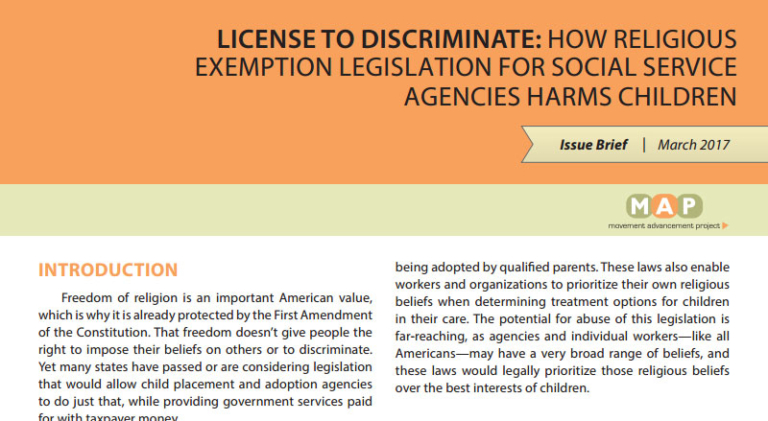
The freedom of religion is one of our nation’s most fundamental values, which is why it is already protected in the First Amendment of the U.S. Constitution. Americans also believe in equal treatment, and while religious freedom is important, that freedom doesn’t give anyone the right to harm, discriminate against, or impose their beliefs on others. Yet many states have passed or are considering legislation that would allow child placement and adoption agencies to do just that, while providing government services paid for with taxpayer money

License to Discriminate: How Religious Exemption Legislation For Social Services Agencies Harms Children details how this type of religious exemption legislation hurts children. These laws encourage and enable adoption agencies and their workers to reject parents who don’t share the agency’s or worker’s religious beliefs instead of providing forever homes for children. As a result, children may remain in government group homes and foster care rather than being adopted by qualified parents. These laws also enable workers and organizations to prioritize their own religious beliefs when determining treatment options for children in their care. The potential for abuse of this legislation is far-reaching, as agencies and individual workers may have a very broad range of beliefs, and these laws would legally prioritize those religious beliefs over the best interests of children.

Skip to PDF content
Related resources

Family Leave Laws
State family leave laws covering same-sex couples govern whether an LGBT person can take leave from work to care for their same-sex spouse or partner.
LGBTQ People
LGBTQ people in the United States have families, work hard to earn a living, pay taxes, and serve their communities and their country. MAP offers a collection of resources addressing the many aspects of LGBTQ people’s lives.
LGBTQ Families
LGBTQ families are part of the fabric of neighborhoods and communities across the United States. An estimated two million children are being raised by LGBTQ parents. Decades of research shows that children with LGBTQ parents grow up as happy, healthy and well-adjusted as their peers.
Adoption
There are more than 440,000 children in foster care across the country, with more than 125,000 children waiting to be adopted. LGBTQ people have long served as foster and adoptive parents. Research shows they are more likely to foster or adopt than their peers. Despite this, some states have passed
Talking About Family Recognition Laws & LGBTQ Families
Family recognition laws establish a secure legal relationship between a child and their parent or parents. Learn conversation approaches that help people understand why strong legal child-parent ties are essential to a child’s security and well-being and why families—no matter how they are formed—should be treated equally under the law.
Community Acceptance: Resources for Communities Working with Transgender & Gender Diverse Children

Many people don’t understand what it means to be transgender or gender diverse, so some parents or family members struggle when their child comes out as transgender or gender diverse. It is natural for parents to have questions, and this document, jointly created by the Biden Foundation, Gender Spectrum, and

The Power of Affirming Community: How Local Spaces Support LGBTQ Youth Outcomes
“Every Child Needs a Safe Place”: How Home Life Impacts LGBTQ Youth
Healthy Bodies, Healthy Minds: How Providers Can Best Support LGBTQ Youth

Everyone deserves access to quality health care when they need it. For LGBTQ youth, achieving a healthy life must include being accepted and affirmed for who they are.

Join Our Community

Get research updates, stories, and ways to support.