You are here:

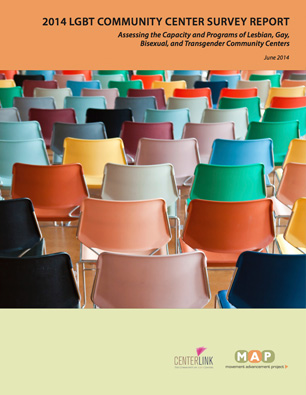
2014 LGBT Community Center Survey Report

Authors

Movement Advancement Project
CenterLink

Report Resources

2014 LGBT Community Center Survey Report: CyberCenters
Download
2012 LGBT Community Center Survey Report
Download
2010 LGBT Community Center Survey Report
Download
2008 LGBT Community Center Survey Report
Download

Recommended Citation

Movement Advancement Project. June 2014. 2014 LGBT Community Center Survey Report. https://mapresearch.org/report/2014-lgbt-community-center-survey-report/.

The Bottom Line

The biennial LGBT Community Center Survey Report provides a detailed picture of centers’ staffs and boards, program priorities, constituencies and services, infrastructure, fundraising, budgets, and technical assistance needs. The 2014 report finds that local community centers serving lesbian, gay, bisexual, and transgender people provide vital information, education, and health services to almost 40,000 people each week.

Abstract

The LGBT Community Center Survey Report, prepared jointly by MAP and CenterLink and published every two years, provides an overview of local lesbian, gay, bisexual, and transgender (LGBT) community centers, including their capacity, their programs and services, the people they serve, and their technical assistance needs.

The 2014 report analyzes data from 111 LGBT community centers, which represent 84% of all LGBT community center expenses. Among the report’s key findings:

  • LGBT community centers serve almost 40,000 people each week (or over 1.9 million people annually). This includes referring over 9,900 people weekly to other organizations or agencies for services and assistance.
  • Both large and small LGBT centers reported revenues increases from 2012 to 2013; small centers experienced a 20% increase in revenues from 2012 to 2013, compared to a 12% increase for large centers.
  • Despite the increase in average center revenue, many centers still struggle with a lack of funding and resources; 21% of all surveyed centers have no staff and rely solely on volunteers; and 57% have five or fewer paid staff. Almost half of center staff (49%) identify as people of color.
  • The demographics of LGBT community center patrons vary greatly among centers. On average however, center patrons are disproportionately male, people of color, transgender, and/or low-income.
Related resources

History of MAP: Tracking Equality and Democracy Through State Policy
In this second installment of our “History of MAP” series, we highlight MAP’s extensive collection of policy research — from its origins in the early 2000s to its most recent expansion through the Democracy Program.
Support for Transgender People is Higher Than Headlines Suggest
This partner brief from MAP and Advocates for Trans Equality (A4TE) offers new analysis which shows that transgender people are widely accepted and supported by their families, workplaces, faith communities, and more.
Democracy Maps Updates: June 2026
History of MAP: Analyzing the Movement’s Capacity
Equality Maps Updates hero
LGBTQ Equality Maps Updates: May 2026
In this rapidly changing landscape, MAP’s LGBTQ Equality Maps provide a detailed snapshot of the current state of LGBTQ laws and policies in the United States. See below for a listing of state level policy changes and MAP’s bill tracking updates as of May 26, 2026.
Mapping Democracy
This collection of voting and election-related resources includes periodic updates of state level policy changes, comprehensive retrospectives, legislative wrap-ups and forecasts.
Mapping Equality
This collection of LGBTQ-related resources includes periodic updates of state level policy changes and bill tracking, comprehensive retrospectives, legislative wrap-ups and forecasts.
The Supreme Court’s Decision to Gut the VRA Means State-Level Protections are More Important Than Ever
This analysis details the impact of the Callais decision and how states have responded to SCOTUS weakening the federal Voting Rights Act.
Talking About ID Update Bans hero image
Talking About ID Update Bans
Identification documents are vital keys that open doors to so many parts of everyday life. Learn about conversations that can help conflicted audiences understand what’s at stake when states seek to ban transgender people from updating the gender marker on their ID.

Join our community

Get research updates, stories, and ways to support.