You are here:

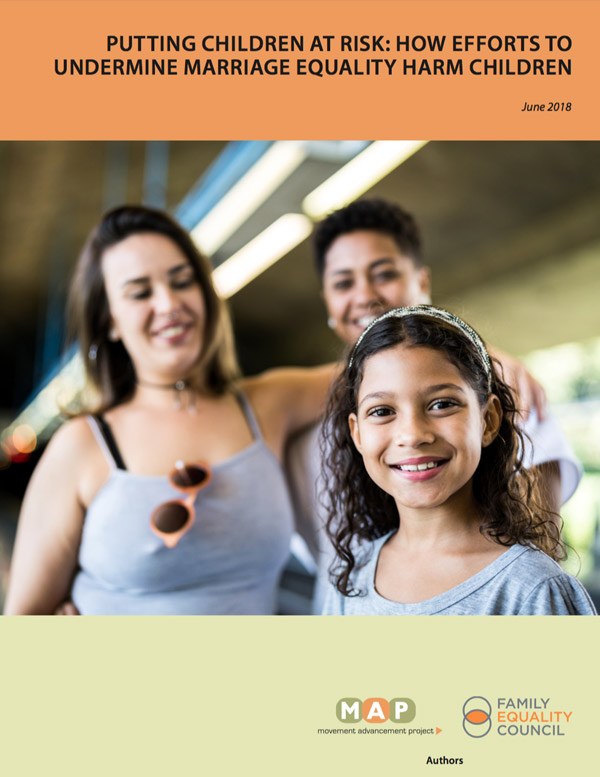
Putting Children at Risk: How Efforts to Undermine Marriage Equality Harm Children

Authors

Movement Advancement Project
Family Equality Council

Report Resources

Putting Children at Risk: How Efforts to Undermine Marriage Equality Harm Children
Download
GRAPHIC: Putting Children at Risk: How Efforts to Undermine Marriage Equality Harm Children
Download

Recommended Citation

Movement Advancement Project and Family Equality Council. June 2018. Putting Children at Risk: How Efforts to Undermine Marriage Equality Harm Children. https://mapresearch.org/report/putting-children-at-risk-how-efforts-to-undermine-marriage-equality-harm-children/.

The Bottom Line

Putting Children at Risk: How Efforts to Undermine Marriage Equality Harm Children shows how these coordinated efforts pose a profound threat to the children in LGBT families.

First, some government officials, state legislators, and courts have refused to fully recognize the marriages of same-sex couples and their relationship with their children. Second, there is an increase in individuals, businesses, child welfare providers, healthcare providers, government contractors, and even government employees claiming they have a right to discriminate not just against LGBT people, but also against the children of LGBT people, because of their religious beliefs. These license-to-discriminate efforts are reflected in legislation, court cases, and agency guidance around the country.

By refusing to recognize the marriages of same-sex couples, and by attempting to insert religious exemptions into nondiscrimination laws that protect LGBT people, the report concludes that the threats to LGBT families and their children are real and, in states without nondiscrimination laws and in states where legislatures have pushed religious exemption laws, the ultimate result is that children are harmed.
Related resources

Family Leave Laws
State family leave laws covering same-sex couples govern whether an LGBT person can take leave from work to care for their same-sex spouse or partner.
Nondiscrimination Laws
Non-discrimination laws protect LGBTQ people from employment, housing, public accommodations, credit, and other discrimination.
Parental Recognition Laws
Legal recognition of the parent-child relationship ("parentage") is important for many reasons, from healthcare decisions and school settings to economic security, everyday life, and much more. These maps illustrate some of the pathways to parental recognition that are especially important for LGBTQ families.
Religious Exemptions
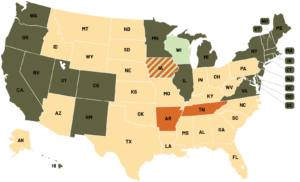
State religious exemption laws permit people, churches, non-profit organizations, and sometimes corporations to seek exemptions from state laws that burden their religious beliefs. These laws have recently been used as a defense when businesses discriminate against or refuse service to LGBTQ customers and same-sex couples.
Marriage & Relationship Recognition
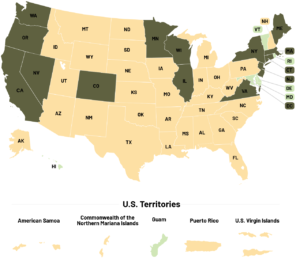
States with the freedom to marry do not ban same-sex couples from entering into legal marriages. However, most states still have constitutional amendments, statutes, or both banning marriage for same-sex couples, even after the 2015 Supreme Court case Obergefell extended marriage equality nationwide.
Targeted: Marriage Solemnization by Public Officials
LGBTQ Families
LGBTQ families are part of the fabric of neighborhoods and communities across the United States. An estimated two million children are being raised by LGBTQ parents. Decades of research shows that children with LGBTQ parents grow up as happy, healthy and well-adjusted as their peers.
LGBTQ People
LGBTQ people in the United States have families, work hard to earn a living, pay taxes, and serve their communities and their country. MAP offers a collection of resources addressing the many aspects of LGBTQ people’s lives.
Talking About Family Recognition Laws & LGBTQ Families
Family recognition laws establish a secure legal relationship between a child and their parent or parents. Learn conversation approaches that help people understand why strong legal child-parent ties are essential to a child’s security and well-being and why families—no matter how they are formed—should be treated equally under the law.

Join our community

Get research updates, stories, and ways to support.