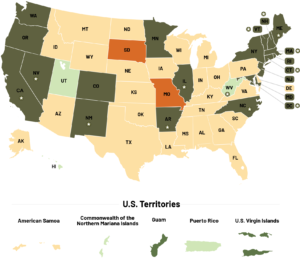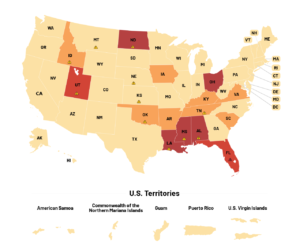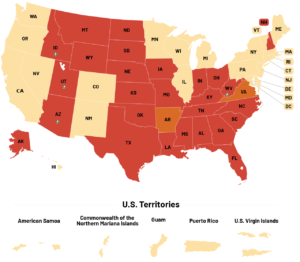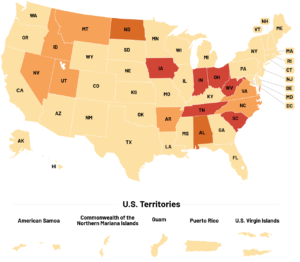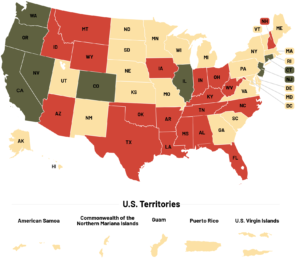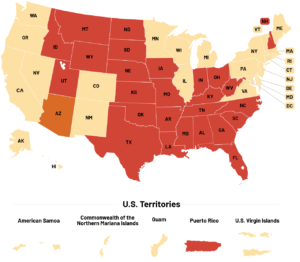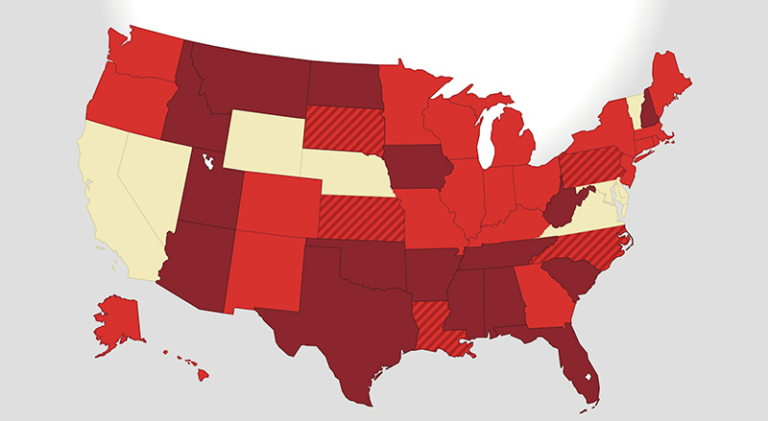
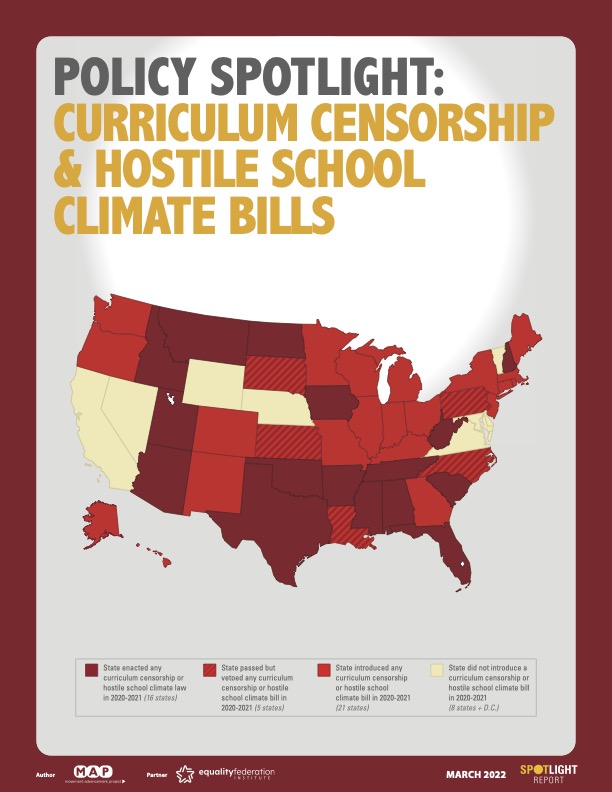
Curriculum Censorship & Hostile School Climate Bills examines the wave of state legislation that censor discussions of race, ethnicity, religion, and LGBTQ people in schools and that create a hostile climate for students.
Curriculum Censorship Bills, including So-Called “Don’t Say Gay” Bills and Bans on Critical Race Theory
School censorship bills ban or severely limit what schools can teach about race, racism, history, sexism, and LGBTQ people and issues, without regard for educational standards. These bills vary widely from state to state. Some of these bills would give politicians veto power over school curricula that discuss the contributions of Black Americans to U.S. history, the Holocaust, or allow parents to sue schools if LGBTQ issues are discussed.
From 2020 to 2021, at least 30 states considered bills that would censor or restrict inclusive curricula. Bills in at least 26 of those states were focused on banning classroom discussions of race and history, with ten states passing them into law. Bills in at least 14 of those states considered “Don’t Say Gay” and other related legislation that specifically seeks to censor discussions of sexual orientation and gender identity, ban LGBTQ-inclusive books or materials, and more.
Hostile School Climate Bills
A growing number of states have also considered or passed bills that undermine a safe, supportive school environment for all students, and especially for LGBTQ youth. Hostile school climate bills take many forms, including requiring teachers and school administrators to “out” an LGBTQ student to their parents, even if the teacher believes they could be kicked out, face physical or verbal abuse, or be subjected to harmful conversion “therapy.” Other bills would ban transgender athletes from school sports, roll back nondiscrimination protections, and restrict use of a student’s chosen pronouns—all of which put transgender and nonbinary students at increased risk of harassment and exclusion.
From 2020 to 2021, least 40 states considered hostile school climate bills. These include bills banning transgender students from playing school sports according to their gender identity, with the number of these bills more than tripling from 2020 to 2021. Many states continue to introduce these bills in 2022.
Additional Key Takeaways
— From 2020 to 2021, at least 42 states considered legislation that would either undermine quality education or a supportive school climate for our nation’s youth.
— From 2020 to 2021 these kinds of bills nearly quadrupled in number and were considered in nearly every state.
— So far in 2022, at least 280 hostile school climate and curriculum censorship bills have been introduced – more than in the previous two years combined.
— These bills are part of a well-coordinated effort by lobbyists and politicians to exploit parents’ fears and frustrations during the COVID-19 pandemic – and to radically reshape our education system. These bills put the partisan and political interests of politicians ahead of the independence of educators and the needs of children.
Implications
In 2020 and 2021, over 59 million young people—more than 80% of the nation’s youth—lived in the 42 states that considered these kinds of bills. Even when those bills did not become law, the public debate about them causes harm. A 2021 survey by The Trevor Project showed that two-thirds (66%) of LGBTQ youth said their mental health was negatively impacted by recent state legislative debates about transgender people.
These bills create a wide range of penalties, including a school losing funding and allowing a parent to sue a school if they disagree with the curriculum.