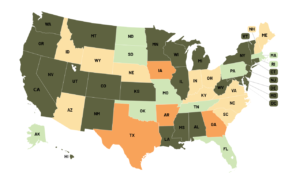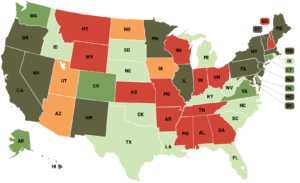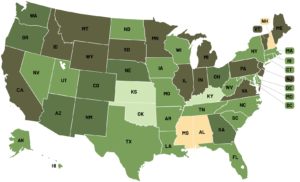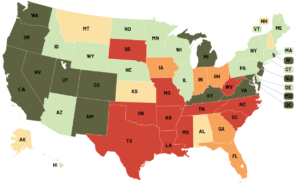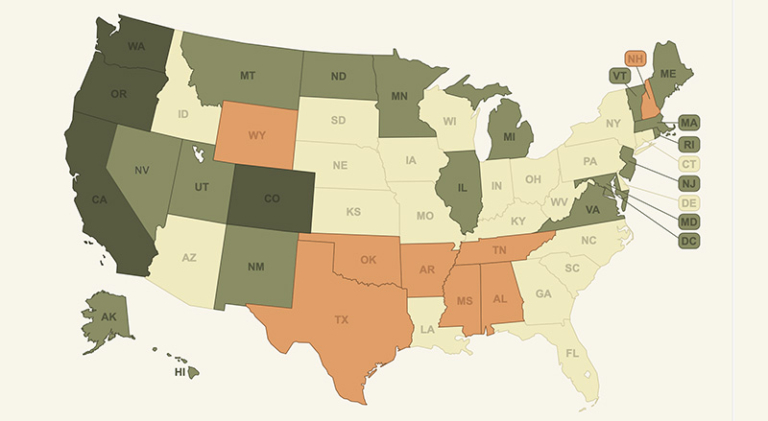
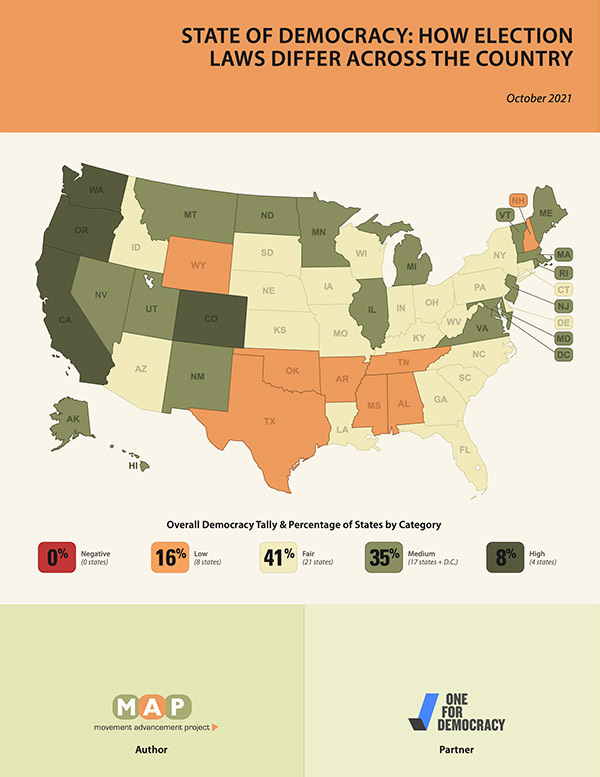
Ahead of the 2022 midterm elections, many states have enacted laws designed to create election barriers when it comes to a hallmark of American democracy: the freedom to vote. MAP’s report, State of Democracy: How Election Laws Differ Across The Country, provides a comprehensive analysis on state election and voting laws across the United States, revealing how access to democracy varies drastically based on where one lives.
Key findings from the report include:
- Three in five voters (141 million voters) live in states that rank in the bottom half of the Democracy Tally. Of those, 38 million voters live in states with “low” ratings, with a majority of states in the South ranking in the bottom half of the Tally.
- States with the most restrictive election laws have the lowest voter turnout. Of the 10 states with the lowest voter turnout in 2020, seven also fall into the bottom 10 states in the Democracy Tally.
- States that are no longer subject to critical portions of the Voting Rights Act have some of the lowest Democracy Tally scores. Of the nine states formerly covered by the Voting Rights Act, seven are ranked in the bottom half of our Democracy Tally.
- Certain states and politicians are manufacturing false claims about election security as justification for passing restrictions on voting instead of laws and policies that would truly lead to more secure elections. For example, in 2021 Texas used false claims about election security as pretext to pass laws that allow the state legislature to restrict voting and interfere with election officials. Yet the vast majority of the state lacks voting machines with auditable paper trails and has not implemented the risk-limiting audits that are widely accepted as a best practice to protect elections from tampering and foreign interference.
- The largest differences across states are the laws and policies about how to vote. Alabama, for example, has a negative score due to extremely restrictive policies that limit voter participation for both voting in-person and by mail. Arkansas, Mississippi, and South Carolina all have negative scores in how to vote categories, and eight states are ranked as low.
The report findings are based on the newly launched Democracy Maps, which currently track more than 40 election laws and policies across the 50 states and the District of Columbia. The 44 policies tracked by the Democracy Maps fall in the categories of voter registration; in-person voting; voting by mail; election security; representation and participation; and independence and integrity. The Democracy Maps and state ratings will be updated in real time as states enact new policies.
At a time when many states are enacting restrictive voting laws, the Democracy Maps are a roadmap for how states can optimize civic engagement and protect the security, integrity and independence of our elections.