You are here:

Invisible Majority: The Disparities Facing Bisexual People and How to Remedy Them

Authors

Movement Advancement Project

Partners

American Foundation for Suicide Prevention
BiNet USA
Bisexual Organizing Project
Bi Queer Alliance
Bisexual Resource Center
Center for Culture, Sexuality, and Spirituality
Los Angeles Bi Task Force (LABTF)
National Black Justice Coalition
National Coalition of Anti-Violence Programs
National LGBTQ Task Force

Report Resources

Invisible Majority
Download

Recommended Citation

Movement Advancement Project. September 2016. Invisible Majority: The Disparities Facing Bisexual People and How to Remedy Them. https://mapresearch.org/report/invisible-majority-the-disparities-facing-bisexual-people-and-how-to-remedy-them/.

The Bottom Line

During the past decade, the United States has witnessed growing understanding and acceptance of lesbian, gay, bisexual, and transgender (LGBT) people and increased legal protections based on sexual orientation and gender identity. Rarely, however, have the experiences and lives of bisexual people, who comprise more than half of the entire LGBT community, been explicitly considered in the social or legal narrative. Rather, bisexual people are frequently swept into the greater lesbian, gay, and bisexual (LGB) community, their specific disparities made invisible within data about the LGB community as a whole.

Invisible Majority: The Disparities Facing Bisexual People and How to Remedy Them focuses on the “invisible majority” of the LGBT community, the nearly five million adults in the U.S. who identify as bisexual and the millions more who have sexual or romantic attraction to or contact with people of more than one gender. The report provides an overview of current research so we can better understand those who comprise the largest share of the LGB population. It also examines how bias, stigma, discrimination, and invisibility combine to create serious negative outcomes for bisexual people, and it provides concrete recommendations for change. Finally, sidebars throughout the report highlight the lived experiences of bisexual people—and the pervasive discrimination and key disparities they face.
Related resources

Hate Crime Laws: Data Collection
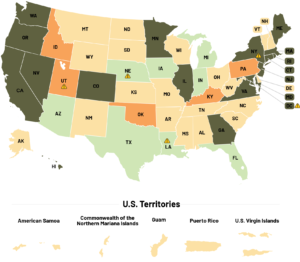
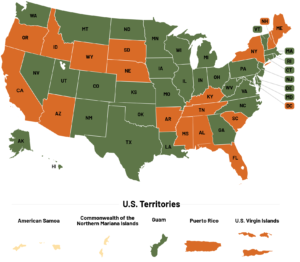
This map shows both what states require hate crimes data collection, and of those states, which specifically require data collection about hate crimes based on sexual orientation and gender identity.
Data Collection
These maps detail states that include questions about sexual orientation and gender identity in the Behavioral Risk Factor Surveillance System (BRFSS) and the Youth Risk Behavior Surveillance System (YRBSS) surveys, respectively.
LGBTQ People
LGBTQ people in the United States have families, work hard to earn a living, pay taxes, and serve their communities and their country. MAP offers a collection of resources addressing the many aspects of LGBTQ people’s lives.
Bisexual People

Bisexual people live in every state and are ethnically and racially diverse. Research shows that more women identify as bisexual than men. Bisexual people are parents, teachers, athletes, writers, politicians, musicians, artists, and more. While bisexual people comprise more than half of the lesbian, gay, and bisexual population, they often

Data Equity

Although data collection efforts play a central role in government decision-making and resource allocation, LGBTQ people largely remain invisible to local, state, and federal officials who make decisions that directly affect their safety and wellbeing. This lack of LGBTQ inclusive data significantly hinders the ability of advocates and policymakers to

MAP Spotlight: Leveraging Data to Advance LGBTQI+ Equity
This spotlight details MAP's data policy portfolio, which focuses on ensuring that SOGI data are collected, protected, and used by the government in ways that advance evidence-based policymaking, civil rights enforcement, effective service delivery, and intersectional research, while pushing back against efforts to weaken privacy safeguards and misuse data.
LGBTQ Data at the Census Bureau: What’s Changed and Why It Matters
Thiss piece is written by Caroline Medina, MAP’s Senior Advisor for Data Policy and Strategy, and originally appeared in Standard Deviations, a blog published by The Census Project.
One Year In: The Cost of Rolling Back Federal LGBTQ Data
To dig into the impact of the administration’s removal of sexual orientation and gender identity (SOGI) measures, Melanie Klein at dataindex.us sat down with Caroline Medina, MAP’s Senior Advisor for Data Policy and Strategy.
The Federal SOGI Data Landscape Under the Second Trump Administration: One Year In Review
This report reviews recent progress in federal LGBTQ data collection, documents the scope and consequences of current demographic data removals and rollbacks, and outlines strategies and resources to promote accountability and responsible data governance in an increasingly hostile federal environment.

Join our community

Get research updates, stories, and ways to support.